Media
Books we keep going back to while building this place — on how these worlds are found, what a measurement can honestly tell us, and what might live on them. A short shelf on purpose: every one of them is worth the evening.
Books
 The Little Book of ExoplanetsJoshua WinnWinn analyses transit data for a living — he is one of the astronomers behind Kepler and TESS — and this is the rare short book that explains the measurement before the conclusion. It walks through how a wobble in a star's light becomes a mass, a radius and an orbit, and is candid about how much of the rest is inference. If you have ever wondered what the numbers on one of our exoplanet pages actually rest on, this is the book that answers it.Princeton University Press · 2023
 Exoplanets: Diamond Worlds, Super Earths, Pulsar PlanetsDiamond Worlds, Super Earths, Pulsar Planets, and the New Search for Life beyond Our Solar SystemMichael Summers & James TrefilA tour of the categories rather than the instruments: worlds of carbon that crystallise into diamond, super-Earths with no analogue at home, ocean planets hundreds of kilometres deep, and the planets that somehow survive around pulsars. Summers and Trefil are unusually good at explaining why each type forms where it does. It maps closely onto the classifications our own simulation assigns, which makes it a useful companion to browsing the directory.Smithsonian Books · 2018 · 224 pages
 Envisioning ExoplanetsSearching for Life in the GalaxyMichael CarrollCarroll is a space artist, and this is the book about the problem we spend most of our time on here: how do you picture a world from a mass, a radius and an orbital period? It sets his paintings beside the data they came from and the reasoning in between, with a foreword by Elisa Quintana of NASA Goddard, who led the Kepler-186f discovery. The most directly relevant book on this shelf to what TerraForge is doing.Smithsonian Books · 2020 · 224 pages
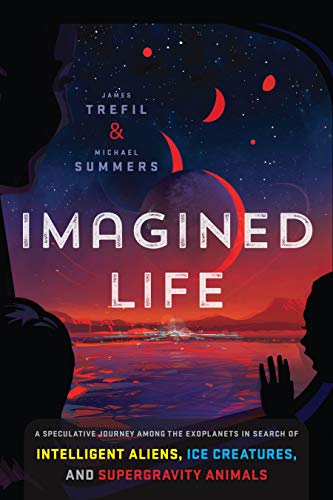 Imagined LifeA Speculative Scientific Journey among the Exoplanets in Search of Intelligent Aliens, Ice Creatures, and Supergravity AnimalsJames Trefil & Michael SummersTakes the world types seriously and asks what could actually live on each one — under the ice shell of a frozen ocean moon, in the permanent twilight band of a tidally locked planet, or under a gravity that rules out anything tall. The speculation is disciplined: every creature is argued from the chemistry and the energy budget rather than imagined first. Read it after scoring a world here and the habitability number stops being abstract.Smithsonian Books · 2019 · 240 pages